


Electronic devices’ complex form factors and strong performance are changing their internal architectures at a rate never seen before. Functional integration in small places has reached its limit thanks to multi-layer PCB stacking technology. But along with this improvement in performance comes an increase in the complexity of maintenance. At the cutting edge of technology in 2026, we are using a new generation of diagnostic tools to address the difficulties of precisely evaluating and fixing these complex systems at the micrometer level.
Understanding Multilayer PCB Failures
Multilayer PCBs are designed to handle high-density circuits, but their layered structure makes faults difficult to identify. Issues such as short circuits, broken traces, or hidden component failures often occur beneath the surface, invisible to the naked eye. Traditional diagnostic methods are no longer sufficient for such complexity.
Failures in these boards can result from overheating, manufacturing defects, or physical damage. Without accurate tools, identifying the exact fault location can be time-consuming and unreliable. This is where modern diagnostic technology plays a crucial role.
The Power of Thermal Imaging in Diagnostics
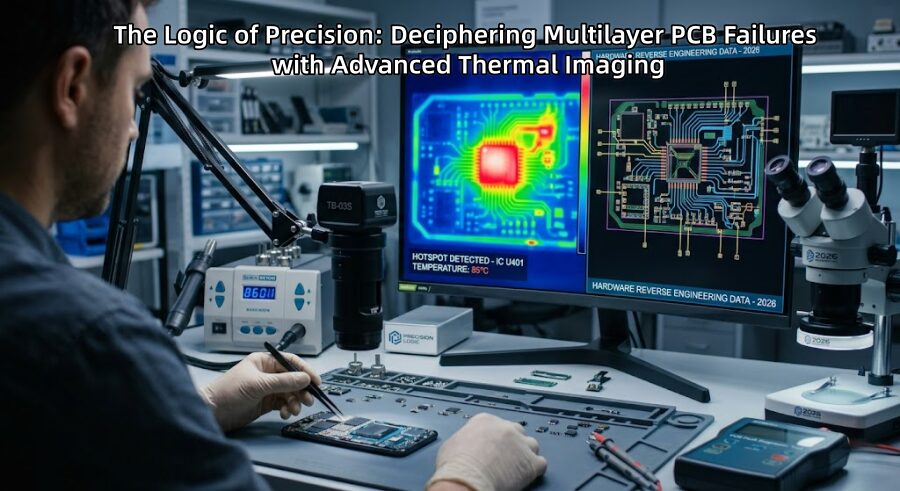
One of the most effective solutions for identifying hidden PCB faults is TB-03S Infrared Thermal Camera. This technology allows technicians to visualize heat patterns across a circuit board in real time. Since faulty components often generate abnormal heat, thermal imaging helps pinpoint issues that would otherwise remain undetected.
By scanning a powered PCB, technicians can quickly identify hotspots, irregular temperature distributions, or failing components. This not only speeds up the diagnostic process but also reduces the risk of unnecessary repairs. In high-density boards, where precision is critical, thermal imaging provides a clear advantage.
Hardware Reverse Engineering in 2026
The field of Hardware Reverse Engineering has evolved significantly, especially in the context of phone-PCB diagnostics. In 2026, technicians are not just repairing devices—they are analyzing and reconstructing circuit behavior to understand failures at a deeper level.
This process involves studying board layouts, tracing signal paths, and identifying how components interact. Combined with thermal imaging, reverse engineering enables technicians to detect even the most subtle issues. It transforms repair work into a logical, data-driven process rather than trial and error.
Essential Tools for Precision Diagnostics
To handle modern PCB challenges effectively, technicians rely on a combination of advanced tools:
Precision BGA Rework Station
A Quick 861DW Hot Air Rework Station is essential for working with ball grid array (BGA) components, which are commonly used in smartphones and compact devices. These components are mounted beneath the chip, making them difficult to access. A rework station provides controlled heating and precise alignment, allowing technicians to safely remove and replace these critical parts without damaging the board.
PCB Fault Diagnostic Tool
A reliable PCB Fault Diagnostic Tool helps analyze electrical signals, continuity, and voltage behavior across the board. These tools assist in identifying faulty circuits and confirming repair accuracy. When combined with thermal imaging, they create a comprehensive diagnostic approach.
Combining Precision with Efficiency
The integration of thermal imaging, reverse engineering, and advanced repair tools has redefined how technicians approach PCB diagnostics. Instead of relying on guesswork, they now follow a systematic process supported by data and visualization.
This approach not only improves repair success rates but also reduces turnaround time. For professionals, it means delivering consistent, high-quality results, even when dealing with the most complex multilayer boards.
Conclusion
By 2026, “Precision Logic” has emerged as a cornerstone of contemporary electronics repair. Leveraging modern PCB fault detection systems, high-precision BGA rework stations, and infrared thermal imaging technology, professionals are now able to identify faults within multi-layer boards—issues that were once considered “undetectable” challenges. Through Professional mobile phone repair tools, this intricate diagnostic process has evolved into a rigorous science, ensuring that every fault is traceable and every repair is precise and reliable.