



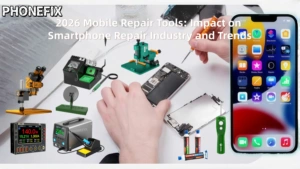
The smartphone repair industry is undergoing a major transformation in 2026. With Mobile devices becoming more compact, powerful, and complex, traditional repair methods are no longer enough. According to recent insights, understanding 2026 mobile repair tools impact on smartphone repair industry and trends is essential for technicians who want to stay competitive and deliver high-quality repair services.
The Shift from Manual Repair to Smart Systems
In the past, phone repair relied heavily on manual skills and experience. However, in 2026, the industry is shifting toward AI-powered Diagnostic tools and automated systems. These tools can quickly analyze both hardware and software issues, reducing the need for guesswork.
Instead of spending hours diagnosing a problem, technicians can now use smart diagnostic tools that generate detailed reports within minutes. This change has significantly improved repair efficiency and reduced human error.
Faster and More Efficient Repair Processes
One of the biggest impacts of modern tools is the speed of repair work. Traditional methods often required full device disassembly to identify faults, but new tools allow for quicker and more accurate detection.
With advanced systems, repairs that once took hours can now be completed in less time. This not only improves productivity for technicians but also enhances customer satisfaction, as users expect quick service in today’s fast-paced environment.
Rise of Predictive Maintenance
Another important trend highlighted in 2026 mobile repair tools impact on smartphone repair industry and trends is predictive maintenance. Modern tools can monitor device performance and detect early signs of failure.
For example, DIYFIXTOOL tools can analyze battery health or memory performance and warn technicians about potential issues before they become serious. This proactive approach helps reduce device failures and improves long-term reliability.
Growing Demand for Precision Tools
As smartphone components become smaller and more densely packed, the demand for high-precision tools has increased. Tools such as digital microscopes, micro-soldering kits, and hot air stations are now standard in repair labs.
These tools allow technicians to perform repairs at a microscopic level, fixing individual components instead of replacing entire modules. This approach not only saves cost but also improves repair quality.
Sustainability and Cost Efficiency
Modern repair tools are also contributing to a more sustainable repair industry. Instead of replacing entire parts, technicians can now repair specific components using precision tools.
Additionally, technologies like 3D printing allow custom parts to be created when needed, reducing inventory costs and electronic waste. This shift supports environmentally friendly practices while maintaining efficiency.
Integration of Robotics and Automation
Automation is becoming an important part of the repair process. Robotic systems are now used for tasks such as battery replacement and screen removal, ensuring consistent and damage-free results.
These systems reduce the risk of human error and improve accuracy, especially when working with fragile components like OLED displays Screen or foldable screens.
Emerging Technologies Shaping the Future
Several advanced technologies are shaping the future of mobile repair:
- AI-driven diagnostics for faster fault detection
- Augmented reality (AR) for remote repair guidance
- Laser repair tools for precise component removal
- Micro-welding technology for advanced motherboard repairs
- 3D printing for custom parts and components
These innovations are not only improving repair quality but also expanding the capabilities of technicians.
Impact on the Repair Industry
The adoption of advanced tools has raised the overall standard of the repair industry. Technicians are now expected to handle complex repairs that were previously impossible. At the same time, the need for proper training and updated knowledge has increased.
Repair shops that invest in modern tools and technologies are better positioned to succeed in this evolving market.
Conclusion
Understanding 2026 mobile repair tools impact on smartphone repair industry and trends is essential for anyone involved in mobile repair. The industry is moving toward smarter, faster, and more precise repair solutions driven by advanced tools and technology.
From AI diagnostics and predictive maintenance to robotics and micro-repair techniques, these innovations are transforming how repairs are performed. As smartphone technology continues to evolve, technicians who adapt to these tools will be able to deliver better results, improve efficiency, and stay ahead in the competitive repair market.
